How to Write a Wedding Toast (Step by Step)
Key Points to Review
A wedding toast (also called a wedding speech or reception tribute) is a short spoken address delivered at a wedding reception, ending with a raised glass. Two to three minutes is the sweet spot. Know what your closing line is before you write the rest.
- Two to three minutes is the sweet spot. Four is too long. Five is a mistake.
- One specific story beats three generic ones every time.
- Write your closing toast line first, then build backward to it.
- Practice out loud at speech volume, not silently in your head.
- Cut any sentence that starts with “I was asked to say a few words about…”
- The actual toast at the end should be one sentence. Raise, say it, drink. Done.
Before You Write a Single Word
Most wedding toast advice jumps straight to structure. For a classic take on etiquette and structure, The Knot has a solid wedding toasts guide. Intro, story, pivot, toast line. That order is fine, but it skips the part that actually makes or breaks a speech before you sit down to write it.
Know What the Couple Actually Wants
Some couples want heartfelt. Some want funny. Most want both. Ask them directly before you commit to a direction. Walking up to that mic with a roast when the couple expected something tender is a longer recovery than you want to manage in front of 150 people.
We’ve watched a best man absolutely demolish the groom for four and a half minutes, completely unprepared for the groom’s mother sitting in the front row who’d never heard any of those stories. The room never fully came back.
Find Out the Logistics Before You Write
Ask three questions before you start:
- How long do I have? Two minutes of comfortable speaking is about 250 to 300 words. Get a number, then write to it.
- When am I speaking? Cocktail hour toasts land differently than dinner toasts. Energy, attention, and alcohol levels are not the same at 6pm versus 9pm.
- Will there be a microphone? A mic lets you slow down. No mic means your nervous pace will cause the back half of the room to miss everything.
The Structure That Works in a Real Room
There are a hundred toast formats. This one is the most reliable in a live reception environment, where attention is contested and champagne is flowing.
The Opening: Don’t Introduce Yourself Yet
Every toast guide tells you to introduce yourself first. Stop. The first fifteen seconds are when you either have the room or you don’t. Burning them on a name and a title is a waste.
Start with something that makes people put down their forks. A bold statement. A specific image. A line that earns a laugh or a lean-in. Then introduce yourself if you have to, but lead with something worth listening to.
Bad: “Hi everyone, I’m Sarah, I’m Emma’s maid of honor, and I’ve known her since college…”
Better: “Emma called me in tears three times the week she met Daniel. I want to be clear, those were good tears.” Written for delivery. The pause before the punchline does the work.
The Story: One, Not Three
Pick one story. A single, specific moment that reveals something true about the person you’re toasting. Not three stories back to back. Not a career highlight reel. One moment, real details.
“Ryan always made time for people” is not a story. “Ryan drove four hours in a rainstorm to help me move a couch in 2019, showed up with coffee, and never mentioned it again” is a story. One of those does something to a room. The other doesn’t.
The story should take about sixty to ninety seconds to deliver. If it runs longer, cut until it doesn’t.
The Pivot: Bring in the Partner
Every great toast pivots from the person you know to who they became with their partner. This is where you earn the emotion or settle for polite applause.
Talk about what you’ve seen change. Or what you hoped for them that you can see they found. One specific observation beats any general statement here.
“She’s happier than I’ve ever seen her” is fine. “The first time I met Daniel, I watched him sit through an hour of her explaining the entire plot of a show he’d already seen, and he asked follow-up questions. I knew then.” That’s the version that gets people.
The Toast Line: One Sentence, Raised Glass
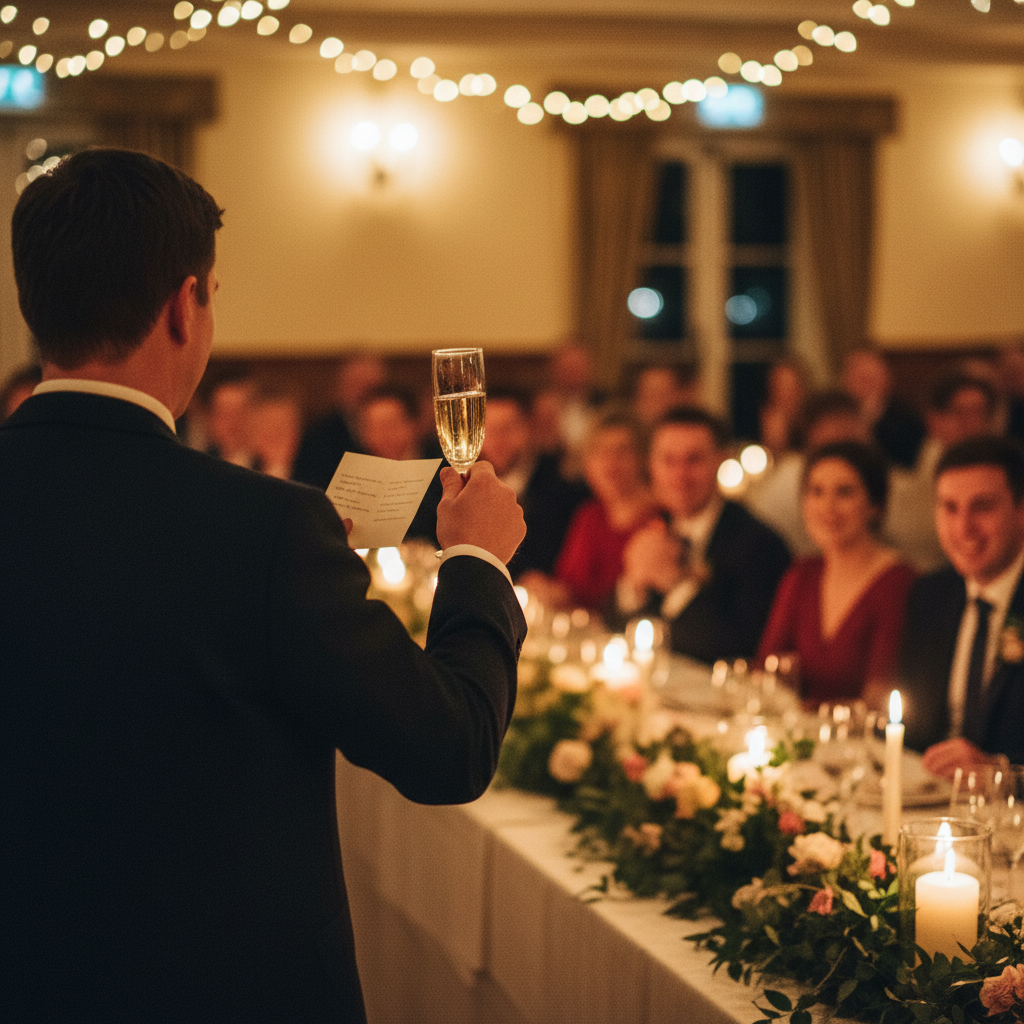
End with a single toast line. Not a paragraph. Not a poem. One sentence, then raise your glass, then everyone drinks.
Write it first, before the rest of the speech. Everything before it should be building toward that line. If you can’t tell what your toast is building toward, that’s the problem to solve.
What to Cut Before You Walk Up
Most toasts are too long. Cut harder than feels comfortable, then cut again.
Cut anything that requires context only you and the couple would have. If you need to explain the backstory for a joke to land, the joke doesn’t land.
Cut inside references that aren’t universal enough. In a reception hall with 120 people, half the room is staring at their phone when the in-group punchline lands.
Cut the apology. “I’m not great at public speaking, so bear with me” asks the room to lower their expectations before you’ve said anything worth hearing. Just start.
Cut any mention of exes. Any. No exceptions.
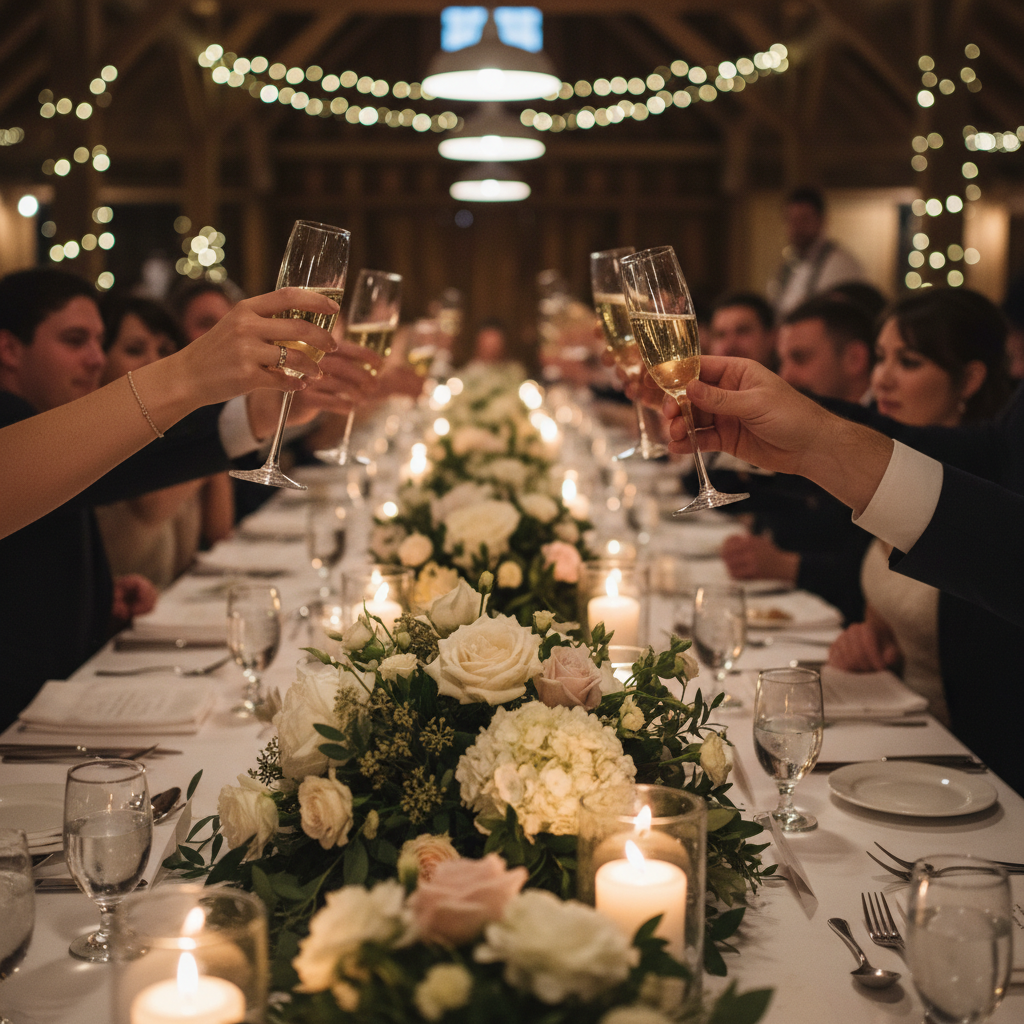
We’ve coached enough people through toast writing to have an opinion: write the closing line first. Not last. If you can’t picture the moment when you raise the glass, you haven’t found the toast yet.
Practice in the Room, Not Just at Home
Practice standing up. Practice at the volume you’ll actually use. Practice with a glass in your hand, because it will feel different and you need to get used to it before the moment arrives.
A toast practiced silently in your head sounds nothing like the one you deliver in a room where everyone is watching. Most people read out loud in their normal voice, then show up in the actual moment going faster, quieter, and more monotone than they expected.
Read it to someone. Film yourself once. It’s uncomfortable. Do it anyway.
The reception speeches that actually move a room are almost always the ones practiced until they felt boring to the person delivering them. By the time boredom sets in, the words are in muscle memory. That’s where you want to be when you pick up that mic.
For real examples of toasts built around this structure, our wedding toast examples guide breaks down what makes each one work and how to adapt it. If you’re working with a tight time limit, short wedding speeches that hit hard shows how to compress the framework without losing the emotional core.
If you are also figuring out when in the reception speeches should happen and who goes in what order, see our guide on wedding speech order.
Wedding Toast vs. Wedding Speech: Is There a Difference?
People use “wedding toast” and “wedding speech” interchangeably, but they’re not exactly the same thing. A wedding speech is any spoken address at a reception. A wedding toast is a specific type of speech that ends with a raised glass and a collective drink. In practice, almost every wedding speech today functions as a toast, but technically a speech can end without one.
The other term you’ll hear is “remarks” (as in “a few brief remarks”). That’s usually the version the father of the bride gives when he’s not going to tell a story but wants to welcome guests formally. A toast, a speech, and remarks are all acceptable at a wedding, but they have different shapes. Know which one you’re giving before you start writing.
FAQs
How long should a wedding toast be?
A wedding toast should run between two and three minutes, roughly 250 to 400 spoken words at a comfortable pace. Four minutes pushes the edge of welcome. Anything beyond that is testing the room’s patience, not their affection for you.
Do I need to memorize the whole thing?
Memorizing the entire toast is not required, but knowing it well enough that you’re barely glancing at your notes is. Looking down at a page while speaking breaks the connection with the room. Know your opening and closing cold. The middle can live on a card.
Is it okay to use humor in a wedding toast?
Humor works well in a wedding toast, with one rule: the joke has to come from affection, not embarrassment. A laugh that makes the couple laugh is great. A laugh that makes the couple cringe is survivable but not what anyone wanted.
What if I get emotional and lose my place?
Pausing when you get emotional is completely fine. Audiences give that room, especially at weddings. Take a breath. Look at a friendly face. Find your place on the page. The room wants you to recover, not perform.
Is a wedding toast the same as a wedding speech?
A wedding toast and a wedding speech are related but not identical. A toast ends with a raised glass and a group drink. A speech can end without one. In practice, most wedding speeches today include a toast line at the end, which is why the terms get used interchangeably. If you’re writing one, plan to include a toast line regardless of what you call it.
Should I have a drink before speaking?
Practice sober. Speak sober or close to it. Two drinks before you go up is the most common reason a toast runs sideways. You feel relaxed, you go off script, you lose your edit, and suddenly you’re telling a story that runs six minutes and involves a detail nobody needed. For another industry perspective, see WeddingWire’s wedding ideas archive.