Wedding MC Script: How to Run a Reception
Key Points
A wedding MC script (also called a reception run-of-show or emcee script) is a set of short, specific prompts for every moment of the reception. An MC who knows the run-of-show cold makes a reception feel effortless. An MC who’s winging it makes every transition feel like a near-miss.
- Total talk time across the night should be under 12 minutes combined.
- Every announcement needs a cue word, a core message, and a clean exit. If you’re still figuring out the role itself, start with how to be a wedding emcee.
- Adjust tone moment by moment: warm for parents, hype for the dance floor, respectful for toasts.
- Print the script. don’t read from a phone. Reading from a phone looks unprofessional.
How This Script Works
This is not a word-for-word script to memorize. Think of it as a set of templates. Customize each line with the couple’s names, the wedding party’s names, and the specific flow of your reception. For additional structural references, see The Knot’s wedding MC guide.
we’ve run receptions with this structure at weddings of every size. The templates hold up. What changes is the personality you bring to them.
The goal is not to sound polished. The goal is to keep the reception moving with warmth and clarity. Pair it with a solid reception entertainment plan and the night runs itself. Guests should feel oriented at every moment.
MC Script vs. Wedding Program vs. Run-of-Show
These three documents serve different purposes. A wedding program is the ceremony order, distributed to guests. A run-of-show (or timeline) is the master document for all vendors, covering every event from setup through breakdown. An MC script (or emcee script) is the MC’s personal reference for what to say and when. The MC script pulls from the run-of-show but contains only the MC’s speaking cues. If someone hands you a full run-of-show and calls it your script, ask them to pull out just your speaking moments into a separate card.
Pre-Reception (5 to 10 Minutes Before Guest Seating)
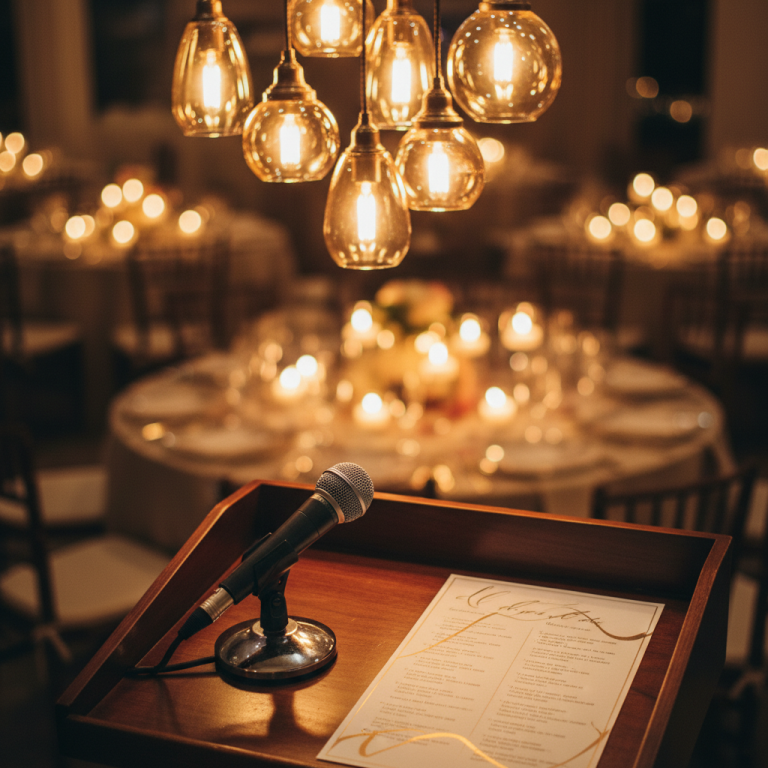
Before guests even sit down, you’re checking the mic, confirming the run-of-show with the DJ and coordinator, and walking the venue.
Checklist:
- Test the microphone. Confirm volume and clarity.
- Confirm cue songs with the DJ.
- Verify the wedding party’s names with pronunciation.
- Confirm the order of speeches with the coordinator or couple.
- Identify the “exit” from each announcement: what song plays next, what happens in the room.
The Opening (90 Seconds)
Your first words set the tone. Warm, confident, under 60 seconds.
Template: “Good evening, everyone. Welcome to the wedding of [Name] and [Name]. I’m [your name], and I’ll be guiding you through the reception tonight. In just a few minutes, we’re going to welcome the wedding party and our newlyweds. Please take your seats.”
Wedding Party Entrance (60 to 90 Seconds)
Announce each pair quickly. Energy should build toward the couple’s entrance.
Template: “Let’s give it up for our wedding party. Starting us off, our bridesmaid [Name] and groomsman [Name]. Next up, [Name] and [Name]…”
Energy note: Speak faster and louder than your normal speech. This is a hype moment.
Couple’s Entrance (30 Seconds)
Pause for effect. Then deliver with full energy.
Template: “And now, for the very first time as a married couple, please give a massive welcome to [Name] and [Name]!”
DJ cue: Song changes from wedding party track to the couple’s entrance song.
First Dance (15 Seconds)
Short, warm, then step back.
Template: “[Name] and [Name], the floor is yours for your first dance.”
Energy note: Low, warm, respectful. The couple is the focus, not you.
Dinner Announcement (30 Seconds)
Transition from high-energy entrance to dinner mode.
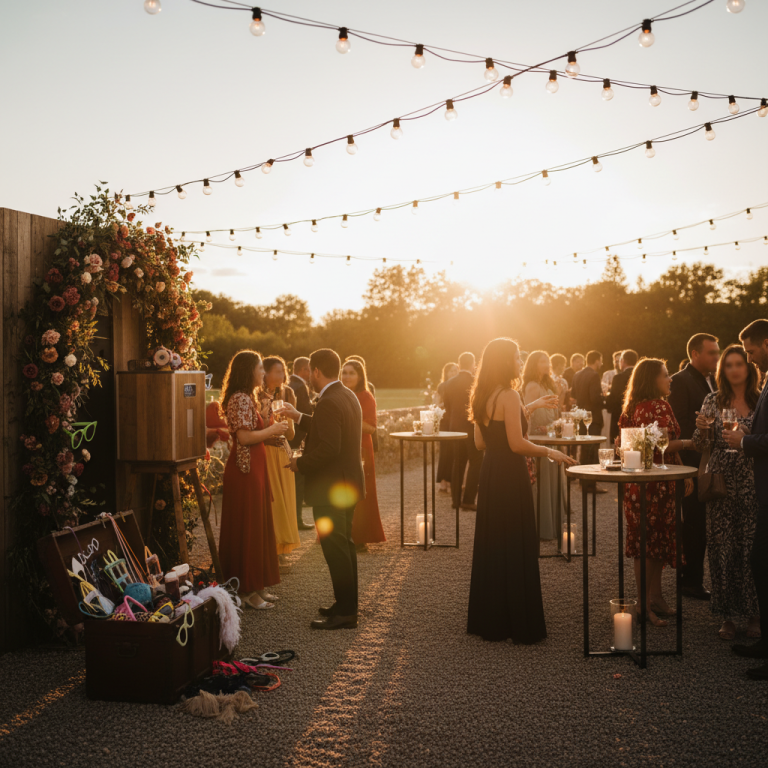
Template: “At this time, we invite you to enjoy your meal. Your servers will be making their rounds. While you eat, feel free to visit the bar, find the photo booth in the back, and of course, raise a glass to our couple.”
Toasts (60 Seconds Each Intro)
One intro per speaker. Keep it short.
Template: “we’re now going to hear from [Name], who has known [Name of couple member] for [X years / relationship]. The floor is yours.”
Energy note: Respectful. don’t steal the moment. The speaker is the focus.
If a speaker runs long, you’ve options. Either let them finish (if they’re clearly wrapping up) or tactfully step back to the mic and say “Thank you so much. Let’s hear it for [Name].” Most overlong speakers pick up the cue immediately.
Cake Cutting (30 Seconds)
Template: “Please join [Name] and [Name] at the cake. This is their first task as a married couple.”
DJ cue: Soft instrumental music during the cutting. Often a cover of “The Way You Look Tonight” or similar.
Parent Dances (60 Seconds Intro)
Template (father-daughter): “[Name] is now going to share a dance with her father, [Father’s name]. The song they chose is [Song title by Artist], which means a lot to them.”
Invite the dance floor to join in at the halfway mark to keep the moment from feeling too theatrical.
Dance Floor Open (15 Seconds)
Max energy. This is the pivot of the night.
Template: “The dance floor is open. Come on up, the party starts now.”
DJ cue: First dance opener song hits the moment you finish.
Mid-Reception Moments (As Needed)
During the dance block, the MC steps in only for necessary cues: bouquet toss, anniversary dance, special performances.
Template: “Taking a quick moment for our anniversary dance. All couples currently married, please come to the floor.”
Late-Night Food Announcement (30 Seconds)
Template: “Hungry? we’ve [tacos / pizza / sliders] set up at the back. Go grab some, then get back on the floor.”
Last Song (30 Seconds)
This is the final peak. Sell it.
Template: “Ladies and gentlemen, this is our last song of the night. One more for [Name] and [Name]. Get on the floor and send them off right.”
Closing (30 Seconds)
Template: “Thank you all for celebrating with us tonight. Drive safe, travel home well, and congratulations one more time to [Name] and [Name].”
What to Put on Your Script Card
Print a single card with bullet points. One side only. Use this structure:
- Cue word (what triggers this announcement)
- 3 to 5 keyword bullets (not full sentences)
- DJ cue song (what plays next)
- Next announcement cue (what you do next)
For more on the MC role overall, see our piece on what a wedding MC is and whether you need one.
FAQs
How long should the MC script be in total?
The MC script in total should come out to about 8 to 12 minutes of spoken time across a 4-hour reception. Each individual announcement is 15 to 90 seconds. A script that adds up to more than 15 minutes of talking is over-scripted.
Can I write the MC script myself?
You can write the MC script yourself if you’ve clear timing for each segment. Use this piece as a template. Customize each prompt with your names and specific order of events. don’t try to write full paragraphs; use bullet points.
Should the MC memorize the script?
The MC shouldn’t memorize the script word-for-word. They should memorize the structure and know the cue words by heart. Reading from a card between announcements is fine as long as the delivery is warm and natural.
What if the reception runs behind schedule?
If the reception runs behind schedule, the MC shortens announcements (to 15 to 30 seconds each) and cuts any optional moments (anniversary dance, bouquet toss). The priority is keeping the dance block intact. Cut the speeches before cutting dance time. For more MC and reception-flow references, see WeddingWire’s wedding ideas archive.
Is the MC script the same as the run-of-show or wedding timeline?
No. The run-of-show (or wedding timeline) is the master document for all vendors, covering every event from setup to breakdown. The MC script (or emcee script) is the MC’s personal reference containing only their speaking cues. The MC script is derived from the run-of-show but stripped down to just the lines the emcee actually says. If someone hands you the full vendor timeline and calls it your script, ask them to pull out your specific cues into a separate card.